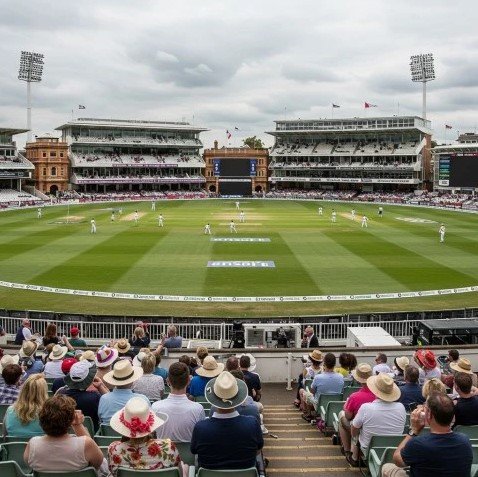
Cricket grounds in England are not just fields of grass; they are living museums filled with centuries of history, eccentric traditions, and quirks that you won’t find anywhere else in the world. From structurally uneven outfields to taxidermied wildlife, here are five of the most unique and bizarre facts about England’s iconic cricket stadiums.
1. The Great Outfield Tilt: Lord’s Famous 8-Foot Slope
While modern sports stadiums are engineered to be perfectly flat, Lord’s Cricket Ground features a massive geographical oddity. The playing surface has a noticeable 2.5-meter (roughly 8.2 feet) slope running across the outfield from north to south. This uneven pitch drastically alters how a cricket ball bounces and rolls, creating an unpredictable environment where both batsmen and bowlers must constantly alter their angles to survive.
2. Frozen in Time: The Tragic Tale of the Lord’s Sparrow
Housed inside the prestigious Lord’s Museum sits one of the strangest pieces of sports memorabilia in existence: a stuffed sparrow mounted directly onto a cricket ball. During a match in 1936, Cambridge University bowler Jahangir Khan delivered a ball that struck a flying sparrow mid-air, killing it instantly. The bird was preserved, attached to the match ball, and has remained a permanent exhibit for nearly a century.
3. The Trophy That Never Leaves Home: The Ashes Urn
The Ashes is one of cricket’s oldest and most fiercely contested rivalries, yet the actual physical trophy never travels to the winning nation. The tiny, original terracotta Ashes Urn resides permanently inside the MCC Museum at Lord’s. Even if Australia completely dominates and wins the series on English soil, they are only ever handed a replica trophy to celebrate with before going home.
4. Breaking 212 Years of Tradition: The 2026 Women’s Test
Steeped in rigid tradition, Lord’s has historically faced criticism for its slow embrace of the modern game. However, 2026 marks a monumental shift in the venue’s timeline. For the first time in its 212-year history, Lord’s will host an official Women’s Test Match. This long-awaited debut represents a historic milestone for gender equality at the spiritual home of cricket.
5. Architectural Anomalies: The Straight-Edged Outfields
Unlike the symmetrical, circular stadiums found across Australia, India, and South Africa, England’s historic venues are famously misshapen. Grounds like The Oval and Old Trafford were built into tight, pre-existing urban neighborhoods during the Victorian era. As a result, many English stadiums feature highly irregular boundaries, sharp corners, and historic pavilion brickwork sitting directly against the boundary ropes.